
Interoception: The Hidden Sense
From elementary school age we can likely name the 5 senses – taste, smell, touch, sight, and hearing. These external senses allow organisms to respond to their surrounding environment.
In recent decades, however, there has been growing appreciation of the vital importance of an organism’s ability to also sense its internal state, via a process known as interoception.
Through bidirectional signaling between the brain and internal organs and tissues, information is gathered from the various bodily systems, processed by the brain, and then acted upon.1
Interoception
/ˌɪn.t̬ɚ.rəˈsep.ʃən/
the process by which the nervous system senses and integrates signals originating from within the body2
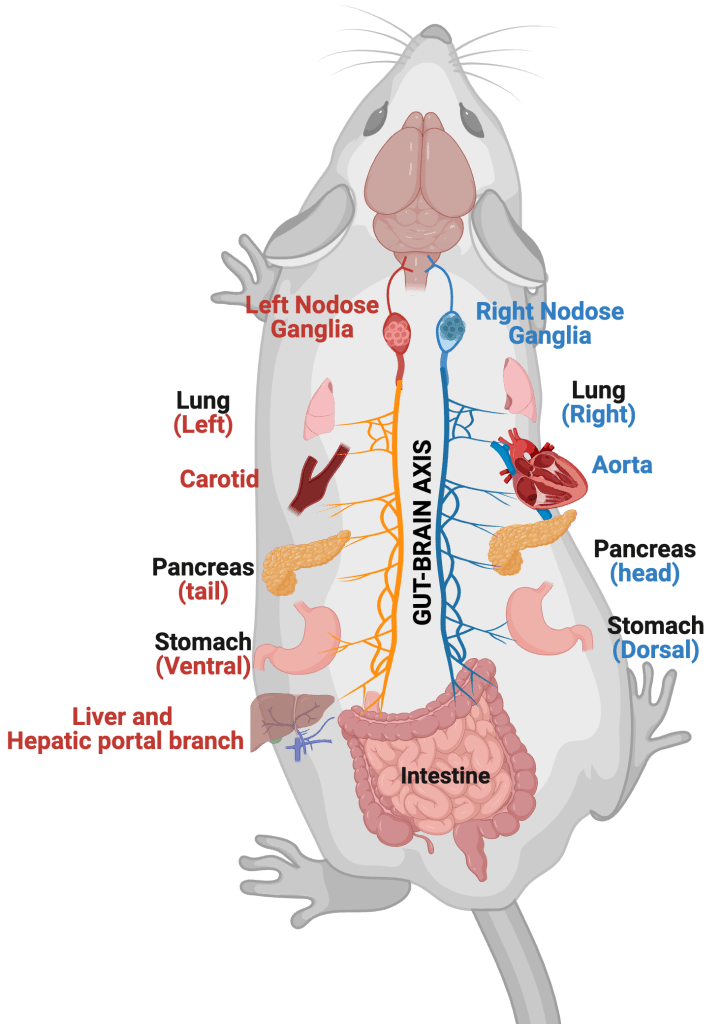
In order to pass information to and from the brain, interoception relies upon the nervous system. In particular, the vagus nerve plays a critical role, its name derived from the Latin for ‘wandering’, due to its sprawling trajectory from the brain to the neck, chest, and, abdomen.3-5
The vagus nerve oversees an array of crucial physiological functions of the body, including breathing, eating, drinking, maintaining body temperature, in addition to regulating emotional state, motivation, and adaptive behavior.3-5
In addition to being the longest nerve in the body, the vagus nerve is also one of the most complex; composed of bundled sensory and motor fibers, carrying a range of signals between the brain and the peripheral organs. The cell bodies of these fibers are located in anatomically distinct regions, with the motor neurons in the hindbrain and the sensory neurons located in nodose ganglia.3-5
Of all the organs supplied by the vagus nerve, the gastrointestinal tract is the most densely innervated. In response to a meal, information about the quantity and type of nutrients ingested is sensed by vagal afferent fibers in the gut and communicated to the brain. The vagus nerve provides information from the gut to the brain that conveys important interoceptive feedback. 6
But many questions remain to be answered, including:
- What is the vagus nerve sensing?
- What are different populations of neurons sensing and which organs do they project to?
- Which neural circuits in the brain are recruited by interoceptive signals?
- How do these interoceptive signals impact physiology, decision making, and behavior?
- How is this altered in disease states?
Projects
Broadly speaking, we’re interested in how the information acquired about internal state via the vagus nerve helps guide decisions and behaviors by balancing internal needs with the demands of the external world, with a particular but not exclusive focus on the regulation of feeding behavior. Since its inception, the de Lartigue lab has provided solid evidence for a role of the vagus nerve in satiety, reward, memory, anxiety, torpor, and obesity.7-13
Techniques
The de Lartigue lab is at the forefront of developing molecular and genetic tools to deconstruct the cellular components of nodose ganglia based on the organs that they innervate, the molecular markers they express, and the stimuli to which they respond. We use the ever-expanding neuroscience toolkit to characterize, map, record, and manipulate subsets of these cellular components that were previously intractable.
References
- Chen, W.G., et al. The Emerging Science of Interoception: Sensing, Integrating, Interpreting, and Regulating Signals within the Self. Trends Neurosci. 2021;44(1):3-16.
- Khalsa, S.S., et al. Interoception and mental health: a roadmap. Biol Psychiatry Cogn Neurosci Neuroimaging, 2018. 3(6): 501-513.
- Prescott, S.L., et al. Internal senses of the vagus nerve. Neuron 2022;110(4):579-599.
- Neuhuber, W.L. and Berthoud H. Functional anatomy of the vagus system – Emphasis on the somato-visceral interface. Autonomic Neuroscience Basic Clin 2021;236:102887.
- Kenny, B.J. and Bordoni B. Neuroanatomy, Cranial Nerve 10 (Vagus Nerve) [Updated 2022 Nov 7]. StatPearls [Internet]. Available from: ncbi.nlm.nih.gov/books/NBK537171.
- de Lartigue, G. Role of the vagus nerve in the development and treatment of diet-induced obesity. J Physiol. 2016;594(20):5791-5815.
- Lee, S.J., et al. Blunted Vagal Cocaine- and Amphetamine-Regulated Transcript Promotes Hyperphagia and Weight Gain. Cell Reports 2020;30(6):2028-2039.
- Han, W., et al. A Neural Circuit for Gut-Induced Reward. Cell 2018;175(3):665-678.
- Suarez, A.N., et al. Gut vagal sensory signaling regulates hippocampus function through multi-order pathways. Nat Commun. 2018;9:2181.
- Krieger, J-P., et al. Neural Pathway for Gut Feelings: Vagal Interoceptive Feedback From the Gastrointestinal Tract Is a Critical Modulator of Anxiety-like Behavior. Biol. Psychiatr. 2022;92(9):709-721.
- Scott, K.A., et al. Mechanosensation of the heart and gut elicits hypometabolism and vigilance in mice. Version 1.bioRxiv July 2023.
- Brierley, D. I., et al. Central and peripheral GLP-1 systems independently suppress eating. Nature metabolism, 2021;3(2), 258-273.
- McDougle, M., et al. Intact vagal gut‐brain signalling prevents hyperphagia and excessive weight gain in response to high‐fat high‐sugar diet. Acta Physiologica, 2021;231(3), e13530.
 de Lartigue Lab